

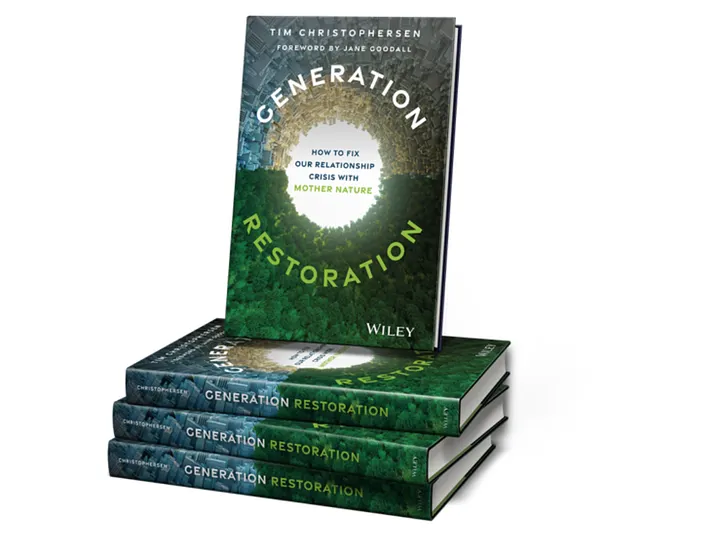
Tim Christophersen’s Generation Restoration couldn’t land at a more pivotal moment. The dialogue around sustainability has become crowded — an alphabet soup of ESGs, CSRs, and new, shifting regulations. But beneath all the jargon is something simpler: our relationship with nature itself. Christophersen’s book calls us back to that foundation, offering not just a roadmap but as a rallying cry to leaders who must reframe how they see the world if they are to lead in the decades ahead.
As he explains, “In my case, I wanted to encourage people to change our relationship with nature collectively. And that means as many people as possible should rediscover their love for nature and their relationship with nature. I mean that in a very literal sense, we are related and we are part of nature.”
That single insight flips sustainability on its head. It’s not about compliance checklists — it’s about a shift in worldview. And the first resource leaders need to tap? Imagination. As Christophersen bluntly puts it, ”We need that political will and the imagination to restore nature at a planetary scale. Because technologically and scientifically, and even financially, it’s not so difficult. It’s not more difficult than putting a person on the moon.”
Nature Isn’t Just Scenery. It’s Infrastructure.
Imagination may be the spark, but finance is the fuel. Christophersen sees a new growth frontier taking shape: “I’m convinced that we will have a trillion-dollar nature restoration industry in a few years. Because once we start to realize that nature is essential infrastructure for humanity, necessary for clean water, for health, for food, and we’re not investing significantly, there will be shifts in the kind of infrastructure level investments we are normally used to seeing only for roads or airports.”
Those shifts are already underway. “Private finance for nature has gone up 11-fold in the last four years to over 100 billion per year, which is about 10% of what we need roughly… It’s an almost exponential solution.” However, he admits the path isn’t easy. “The first 10 is the hardest,” he says, noting how rare it is for financiers to take that kind of first leap. But now, with a few big funds breaking ground, he believes momentum will build. “I think it’s going to be much easier for the ones that come behind them.”
So what does this mean for leaders in the boardroom? That nature isn’t a side issue at all: it’s essential infrastructure. It underpins supply chains, operations, workforce health, and even brand reputation. Christophersen sums it up simply: “Nature is now everyone’s business.”
Today, Christophersen is putting that worldview to work at Salesforce, where he helped launch the Trillion Tree Initiative in 2020 with the World Economic Forum. He explains, “One thing my team is responsible for is to conserve and restore an additional 100 million trees. That’s one of the fun parts of my job.”
He is quick to point out that this isn’t about glossy photo-ops or symbolic pledges. “It’s a big number. So there’s about 3.1 trillion trees on the planet right now. Saying that you want to add a trillion, that’s a pretty hefty number. But first of all, a lot of those trees we have to conserve first. So the trillion includes the trees that we have to make sure are not cut down in the first place.”
That approach is grounded in science and pragmatism. “In most of our successful projects that we funded, we use what is called assisted natural regeneration. So you basically create the conditions for forests to come back and for trees to regenerate themselves. Sometimes you help or you assist that process, but you use nature, you work with nature as an ally, and then it becomes much more feasible.”
And the returns aren’t abstract, they’re visible. Christophersen’s eyes light up when he talks about mangroves. “My favorite example is probably mangroves. You know, the superhero of ecosystems that they are.” He’s right: a third of the ocean’s commercial fish species begin life in their tangled roots. Those same roots double as storm shields for coastal communities. All of that — food, protection, resilience — delivered, as he notes, “for the price of carbon.”
For Salesforce, the Trillion Tree Initiative represents both responsibility and opportunity. Carbon is the baseline, but the multiplier effect — biodiversity, resilience, livelihoods, and food security — creates cascading value across industries and societies.
AI Can Spark Imagination — but It Needs Guardrails
After 15 years at the United Nations Environment Programme, Christophersen made what might seem like an unexpected move: he jumped to Salesforce. Why? Speed. “It is just so rapid. The development,” he shares. “And of course, in the private sector, when there is a new opportunity or a new direction, everybody pivots very quickly, which does not always happen in the public sector… We need a lot of innovation, a lot of bold ambition in climate action… that’s why I joined Salesforce.”
That same sense of urgency shapes how Christophersen looks at artificial intelligence. For him, it’s not just another shiny tool but a way to remove barriers that slow down conservation. “We’re deploying Agentic AI to help NGOs in this space, such as the Forest Stewardship Council. Certifying forests globally is a very complex issue. Many different languages, many different rules. So how can an agent just simplify that and tell that to a forest owner, answer questions in their language around the clock?”
AI, in his view, isn’t only about efficiency — it’s also about imagination. “One of the use cases I’m very hopeful for AI is generating that imagination of what a restored landscape looks like… people respond to that because they suddenly see the world of opportunity, whereas if you look at the degradation of nature, you see a world of scarcity… A world of abundance, triggers opportunity and joy.”
Still, he doesn’t sugarcoat the trade-offs. “It consumes not only a lot of energy, but also a lot of water. So we’re concerned about the water footprint of AI as well, which is why we’re focusing our forest restoration mostly in watersheds that feed into the areas where we have data center dependencies. But I see it as a very powerful tool that can be very useful with a human at the helm.”
The lesson for leaders: innovation must be paired with integrity. AI can accelerate imagination, execution, and transparency, but it must be guided by ecological literacy and operational accountability.
A Playbook for Leaders in the Century of Ecology
For Christophersen, the coming decades aren’t just about new markets or new technologies. He calls it the ‘century of ecology’ — and his warning to business couldn’t be clearer. “We need abundant nature for our economy, our societies, to work. And we also need diverse nature. And the more abundance and diversity you create, the better nature is able to support any business.”
Christophersen warns against treating nature as secondary to human invention. He gestures toward an everyday example: a tree. “We think that we’re smarter than nature. Yet if you just take a simple tree and you think about what kind of complicated and amazing machine that is. Something that is self-replicating, self-healing, and only produces clean air, clean water, food, and timber in the process. No pollution, no waste, no concept of waste. Works for up to a thousand years without maintenance. Show me a machine that can do that.”
Optimism, he insists, is not naïve but necessary. “Optimism in our line of work is mandatory.” Referencing the conditional optimism definition by Paul Romer, he adds, “It’s not something that happens to you, but it’s something you have to cultivate as a mindset.” That mindset, combined with collaboration across government, civil society, and business, is what will scale restoration into the trillion-dollar industry he envisions.
When asked what drives him, Christophersen doesn’t cite markets or milestones. He talks about family. “I hope that my children and their children have a more abundant and diverse world than I did. That’s what I’m working for, at the very least.”
That’s the challenge — and the promise — at the heart of Generation Restoration. Salesforce’s Trillion Tree Initiative is proof of concept: a reminder that imagination, technology, finance, and collaboration can work together to bring life back to the very systems that business, and humanity, depend on.